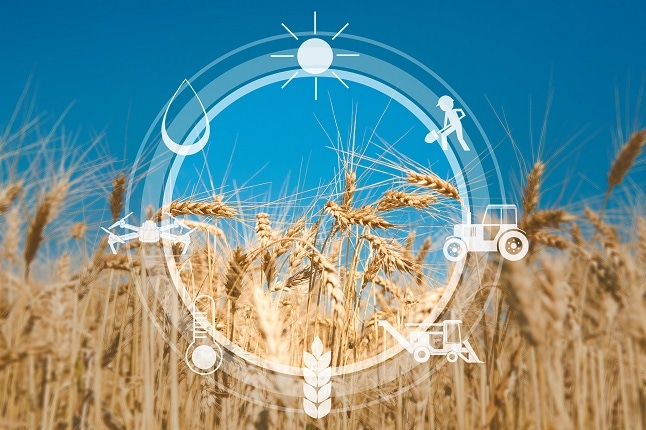
Connected sensors, smart Journalist Drew Maloney tractors, drones, ML, AI farm management software, and smartphone apps are quietly reshaping what has been a low-tech industry. Farming has traditionally focused on maximizing yields at the lowest possible cost. But as environmental concerns have mounted and sustainability has emerged as a critical business issue, agriculture is evolving.
Connected sensors, smart tractors, drones, machine learning (ML), artificial intelligence (AI), farm management software and smartphone apps are quietly reshaping what has been a low-tech industry. These systems are reducing water usage, fuel consumption, the use of fertilizers and, ultimately, carbon output.
“We are seeing enormous advances in sustainable agriculture,” observes Vasanth Ganesan, a partner at business management consulting firm McKinsey & Company. “There is a growing recognition that farmers can achieve a significant return on investment through the technologies they use.”
In fact, McKinsey found that farmers around the world are rapidly shifting to sustainable practices. These include low-tech solutions like low-tilling or no-tilling practices and the use of cover crops to high-tech approaches involving bio-stimulants, bioengineered crops, and IoT systems.
Smart Agriculture Changes Everything
The impact of agriculture on the world’s carbon footprint is enormous. The industry generates about US $2.4 trillion annually and provides jobs for upwards of 1.3 billion people — about 19% of the global population. Yet, according to the United Nations, the industry also has a massive carbon footprint. About 31% of global emissions originate from the world’s agri-food systems.
Addressing this issue is a steep challenge. “There is a great deal of heterogeneity to agricultural systems around the world,” observes Miland Kandlikar, a professor at the Institute for Resources, Environment Sustainability at the University of British Columbia. “There are different economies, machinery, technology, soils, crops and other factors that come into play as you address sustainability.”
Adding to the problem is the fact that deforestation and increasingly complex supply chains are accelerating carbon output. “The most important trend … since 1990 … is the increasingly important role of food-related emissions generated outside of agricultural land, in pre- and post-production processes,” noted Maximo Torero, an economist for the UN.
Nevertheless, advancements in digital technology are beginning to reshape agriculture. Sasha Duchnowski, a partner at consulting firm Bain & Company, says that advances revolve around three primary areas: productivity, precision, and prediction. The right combination of technology and processes allow farmers to apply only the water or fertilizer needed as it’s needed, monitor conditions more effectively, and harness data to drive further gains. “Small year-over-year improvements add up to large scale improvements,” he says.
In fact, more than half of the world’s farms have adopted sustainable practices, according to research conducted by McKinsey & Company. Connected digital sensors monitor crop growth patterns, cattle movement, microclimate data and the pH level of soil. As this data is fed into systems, farmers can adjust and adapt as needed. Analytics software and machine learning systems automatically adapt watering and the application of chemicals. Some farms and ranches have also turned to drones that use multi-spectral imagery to monitor plant health, weeds, animals and soil conditions.
 Site Title
Leave a comment